
This might sound obvious, but how you handle a vinyl record is the single most important skill you can learn. It’s simple: always hold it by its edges and the center label. Never, ever let your fingers touch the grooved playing surface.
Get this one habit down, and you’ve already won half the battle in preserving your collection for a lifetime.
The Art of the Touch: A Foundation in Vinyl Care
Before you start looking at cleaning solutions or fancy storage shelves, let’s get back to basics. Mastering how you physically interact with your records is the first and most critical step for any collector.
Think of it less like a rigid rule and more like developing a natural, gentle touch that eventually becomes second nature. Every time you pull an album out to play it, you're putting this skill to use.
The biggest enemy of your vinyl isn't just dust—it's the natural oils and residue on your hands. When you leave a fingerprint on the playing surface, it acts like a magnet for dust and grime, embedding it deep into the grooves. That’s the number one cause of all those annoying pops, crackles, and hiss that can ruin a listening session.
The Two-Point Contact Method
The safest and most stable way to pick up a record is what I call the two-point contact method. It’s a technique that gives you a secure grip while keeping your fingers far away from the music.
Here’s how it works:
- From the Sleeve: Gently slide the record out of its sleeve. As it starts to emerge, place your thumb on the outer edge and your other fingers right on the center label.
- Lifting and Holding: Use both hands if you need to, but always keep your contact points on the edge and the label. This creates a surprisingly secure grip without putting the grooves at risk.
- Placing on the Turntable: Keep that same grip as you lower the record onto the platter, lining it up with the spindle.
It might feel a little awkward at first, but after a few tries, it’ll become an effortless motion. The goal is to build muscle memory so you never even have to think about how you're grabbing a priceless first pressing.
The impact of just a few fingerprints is bigger than you might think. Dust, skin oil, and static can wear down grooves surprisingly fast. Some industry reports show that up to 70% of all surface noise comes from these exact contaminants. Those oils can even etch into the PVC over time, causing permanent damage. You can dig deeper into the factors that affect a record's lifespan with this in-depth market report.
Every time you handle a record correctly, you're not just protecting its sound quality—you're preserving its long-term value. It's a small investment that pays off in every future listening session.
To make it even simpler, here’s a quick-glance guide to what you should and shouldn't be doing.
Handling Do's and Don'ts At a Glance
This table breaks down the core habits for safely touching and moving your vinyl records, contrasting the right way with common mistakes.
| Action | The Right Way (Do) | The Wrong Way (Don't) |
|---|---|---|
| Picking Up a Record | Hold it by the edges and the center label. | Grab it flat with your palm or pinch the grooved surface. |
| Removing from Sleeve | Gently slide it out, guiding it with your fingertips on the edge. | Yank it out quickly, letting the sleeve scrape the surface. |
| Passing to Someone | Hold it securely by the edges and present it vertically. | Hand it over like a frisbee, forcing them to grab the grooves. |
| Placing on Turntable | Lower it carefully with two hands, using the edge/label grip. | Drop it onto the platter, even from a small height. |
Stick to the "Do's" in this table, and your records will thank you with clean, crisp sound for years to come.
Your Essential Record Cleaning Ritual
Handling your records correctly is the first step, but a consistent cleaning routine is what truly preserves their sound for the long haul. Think of it less like a chore and more like a simple ritual that ensures every spin sounds as crisp and clean as the artist intended.
We'll walk through the two main cleaning scenarios every vinyl lover needs to master. The first is the quick, daily brush-off before you drop the needle. The second is the deeper, wet clean you'll use to bring a dusty thrift store find back to life or just for regular upkeep on your heavy-rotation albums.
The Pre-Play Brush Off
This is your daily driver, the non-negotiable step before every single play. A quick pass with a carbon fiber brush is all it takes. These brushes aren't just for show; their thousands of tiny, conductive bristles perform two critical jobs at once: they dig into the grooves to lift out loose dust, and they safely discharge any static buildup.
Static is a magnet for dust, so neutralizing it helps your records stay cleaner, longer. Just hold the brush gently over the spinning record for a couple of rotations, then carefully angle it to sweep the collected dust off the record's edge. It’s a simple move that makes a world of difference, clearing surface-level gunk right before the stylus makes contact.
This simple infographic breaks down the right way to get a record from sleeve to turntable without leaving a single fingerprint.
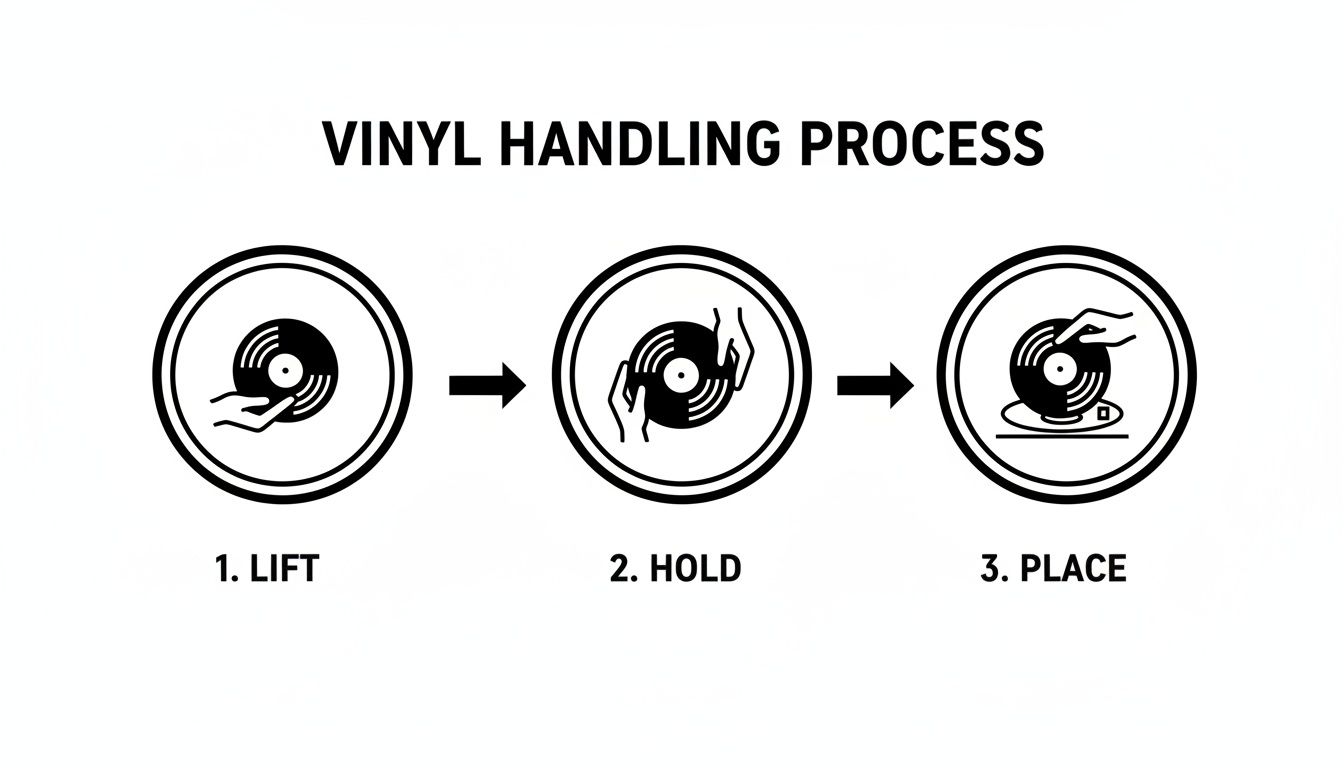
As you can see, minimal contact is the name of the game. It’s the key to preventing smudges before you even start cleaning.
Deep Cleaning With a Kit
For the grime a dry brush can't touch, you'll need a wet cleaning solution. This is your go-to for removing stubborn fingerprints, caked-on dust, and anything else that's settled deep into the grooves. An all-in-one package like the EVEO 4-in-1 Vinyl Record Cleaner Kit is perfect because it gives you everything you need in one place.
Dust is vinyl's biggest enemy. A single speck larger than 10 microns can gouge the grooves, causing what amounts to 50% of audible crackle in some vintage pressings. This is why mastering your handling and cleaning is so important.
Wet cleaning with a proper solution can remove up to 99% of harmful particles, a huge jump from the 60% a dry brush manages alone. It's a difference you can hear. Records that aren't cleaned regularly can lose 2-3 dB of dynamic range every year.
Using a cleaning kit is straightforward and usually involves a few key tools working together:
- Cleaning Fluid: Just a few sprays on the record surface is all you need (always avoid the center label). The formula is designed to break down grime without leaving any residue behind.
- Microfiber Cloth: After applying the fluid, gently wipe the record in a circular motion, always following the direction of the grooves. The cloth lifts away the loosened dirt and absorbs the excess solution.
- Stylus Brush: Never forget the needle! A clean stylus is just as important for great sound and protecting your records. A quick, gentle pass with a small stylus brush removes any gunk from the diamond tip, stopping it from grinding dust into your LPs.
For a more detailed walkthrough, check out our complete guide on how to clean vinyl records for step-by-step instructions.
Proper Storage to Prevent Warps and Damage
Once the music stops, the job of caring for your vinyl is far from over. How you shelve your records is just as critical as how you handle them. I’ve seen it countless times: the single most destructive mistake collectors make is stacking their records horizontally. It seems harmless, but it can cause irreversible damage surprisingly fast.
When you lay LPs flat on top of each other, the weight really adds up. The records at the bottom of that stack are bearing the full burden, which creates immense, uneven pressure. This is the number one cause of warping, bending the record until it’s completely unplayable. It also leads to groove compression and can permanently damage that beautiful album artwork.
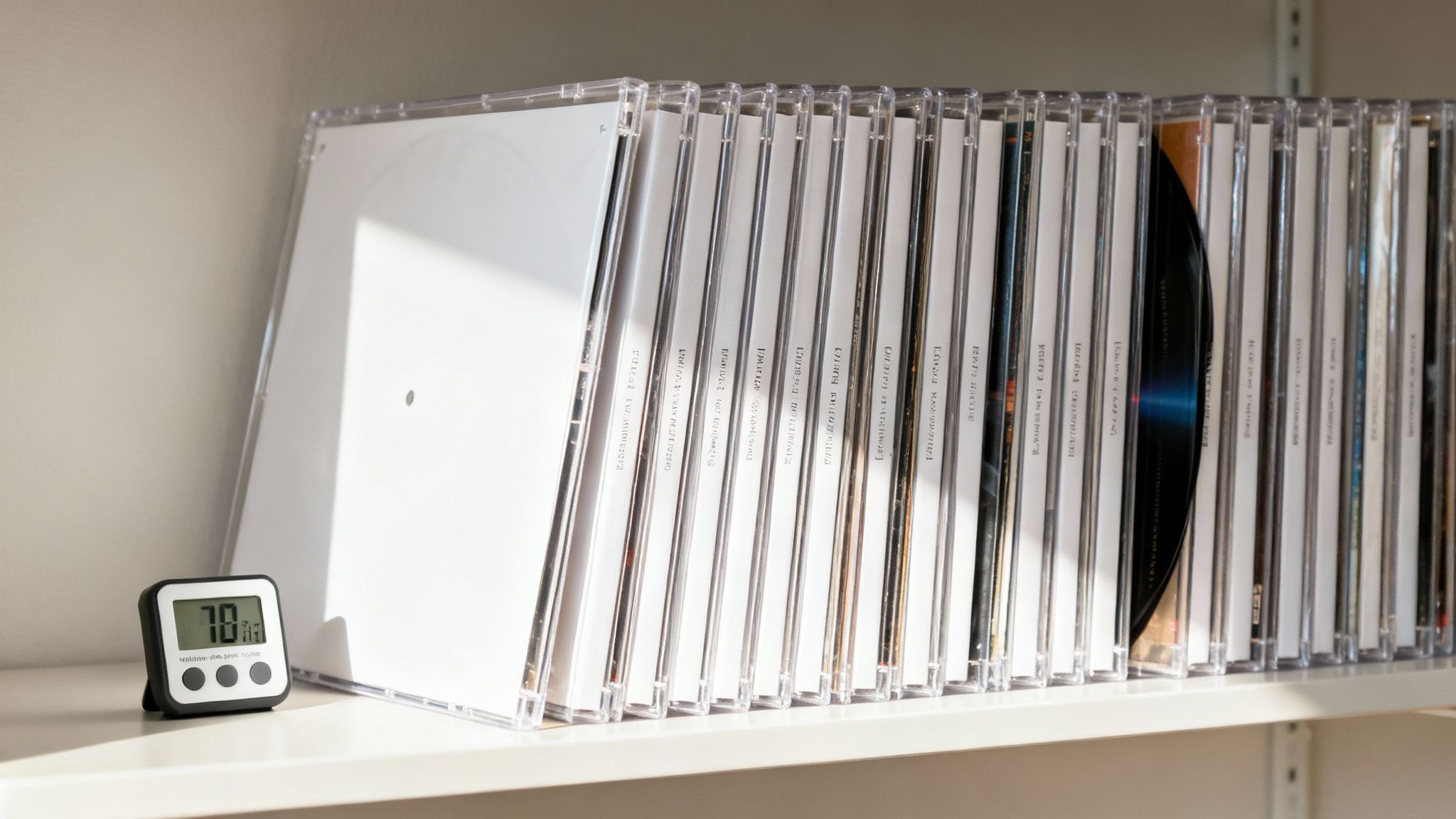
There’s only one safe way to store your collection: vertically. Think of them like books in a library—standing upright and neatly aligned. This orientation ensures pressure is distributed evenly and safely, protecting both the vinyl and its jacket.
The Essential Role of Sleeves
Proper storage isn't just about positioning. It's about creating a protective barrier against the elements. For any serious collector, high-quality inner and outer sleeves are completely non-negotiable.
- Inner Sleeves: Most records ship in basic paper sleeves, which unfortunately create paper dust and can scuff your vinyl over time. Upgrading to archival-quality, anti-static inner sleeves is a total game-changer. They stop static buildup—a major dust magnet—and give the grooves a soft, non-abrasive home. You can dive deeper into the benefits in our article on anti-static record sleeves.
- Outer Sleeves: These clear, protective sleeves are like a force field for the entire album jacket. They defend against dust, moisture, and the dreaded shelf wear that causes ring wear and dulls the artwork. Keeping the jacket pristine is crucial for maintaining the record's overall condition and value.
A global community of collectors understands these principles well. In North America alone, which saw 43 million vinyl units sold in 2023, proper storage prevents an estimated 60% of common damages like seam splits. Surveys reveal that 35% of collectors report warps specifically from horizontal stacking, a completely avoidable mistake. Discover more insights into the thriving vinyl market and its trends on imarcgroup.com.
Creating the Ideal Storage Environment
Vinyl is surprisingly sensitive to its surroundings, especially when it comes to temperature and humidity. Finding the right spot in your home is the key to preventing long-term damage like mold or heat-induced warping.
Your mission is to find a location that is cool, dry, and dark. That means avoiding attics, basements, or garages where temperature and humidity can swing wildly. Direct sunlight is another major enemy; its UV rays can fade album art, and the heat can warp a record in no time.
Keep these ideal conditions in mind:
- Temperature: Stick to a stable room temperature, ideally between 65-75°F (18-24°C).
- Humidity: Aim for a relative humidity between 40-50%. Anything above 60% is a red flag for mold growth.
- Support: Use sturdy shelves that won’t sag under the weight. Purpose-built vinyl storage cubes or strong bookshelves are perfect for the job.
By combining vertical stacking, protective sleeves, and a stable environment, you're creating a true safe haven for your collection. This approach ensures your records will stay in pristine, playable condition for decades.
Transporting Your Records Without Stress
Whether you're bringing home a single new find from the record store or moving your entire library across the country, your vinyl collection needs a game plan. Just tossing a record in the back seat is a recipe for scuffed jackets, bent corners, and the ultimate tragedy: a warped LP. Getting your collection from point A to point B safely is all about minimizing movement and controlling the environment.
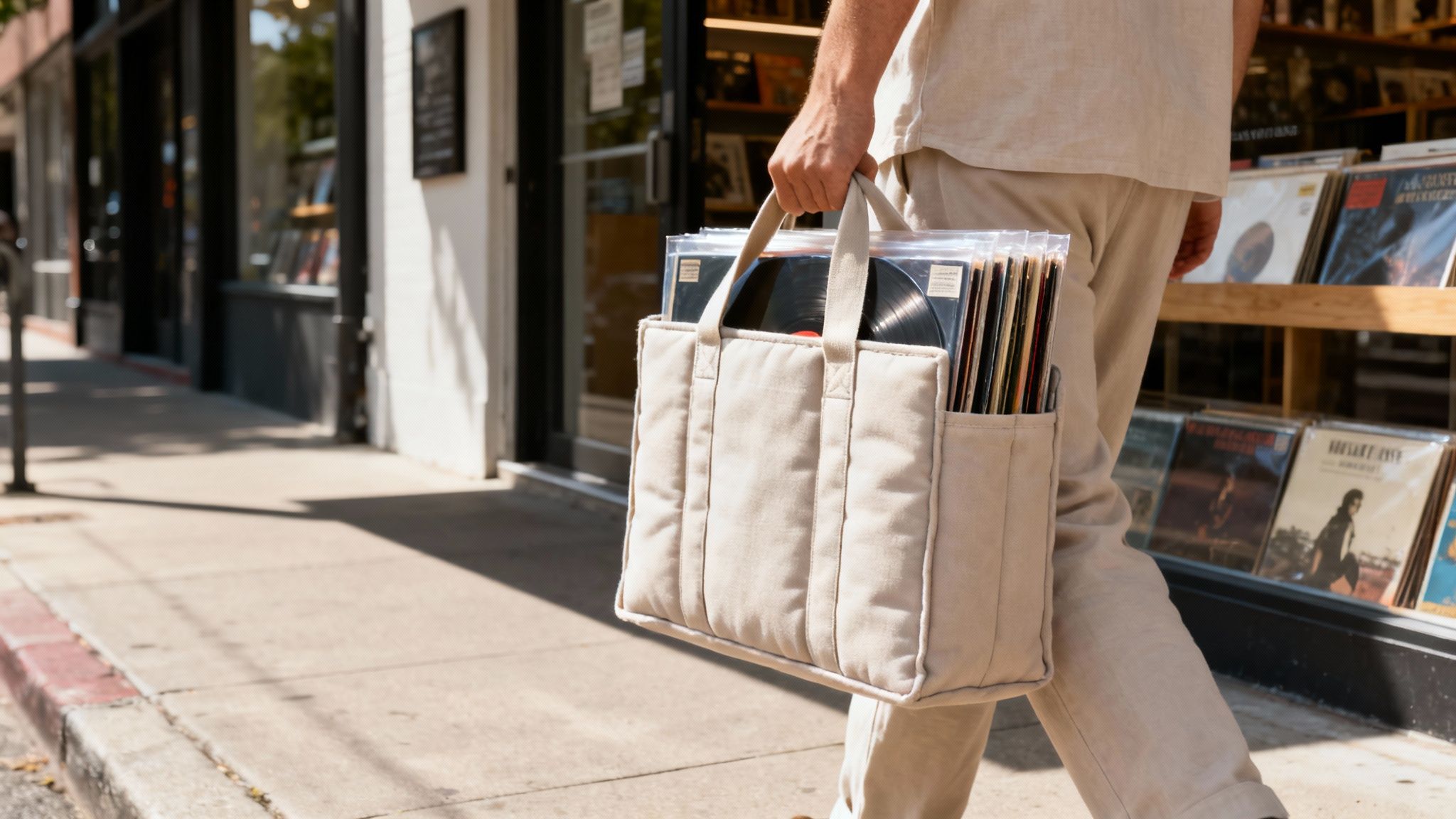
For a quick trip, a sturdy, dedicated tote bag is your best friend. You want something snug enough to keep the record upright and prevent it from sliding around. It’s a simple step that avoids a lot of potential heartache.
Packing for the Long Haul
When it’s time to move the whole collection, the same principles apply, just on a bigger scale. The goal is to pack your records vertically—exactly how you store them on the shelf. They need to be packed in snugly so they can’t shift, slide, or lean during the trip.
- Find the Right Boxes: Small, heavy-duty boxes are what you're looking for. A box around 13x13x13 inches is perfect for 12-inch LPs. Trying to stuff too many into a giant box just makes it dangerously heavy and likely to break.
- Pack Them Snugly: A little padding goes a long way. Line the box with bubble wrap or foam, place the records inside vertically, and then fill any empty space with cardboard inserts or more packing material. No wiggling allowed.
- Label Everything: Tape the boxes up securely and write "FRAGILE" and "VINYL RECORDS - DO NOT STACK FLAT" in big, bold letters. This little instruction can save your collection from being crushed under a box of books.
Your car's interior can turn into an oven on a warm day, hitting temperatures that will soften and warp PVC in minutes. Never, ever leave your records in a hot car, even for a quick errand. Always bring them into the climate-controlled cabin with you.
Climate Control Is Non-Negotiable
Beyond the physical packing, the environment is your biggest enemy or ally. Vinyl is incredibly sensitive to temperature swings. A record left in direct sunlight on a dashboard can start to warp in under an hour. And if moisture gets involved? You’re looking at moldy, ruined album jackets.
To make sure your collection arrives in one piece, always keep your records in a climate-controlled space. If you're on a long-distance move, this means the boxes ride in the car with you, not in a sweltering moving truck or storage unit.
Protection starts before you even pack the box. Investing in high-quality crystal clear outer vinyl sleeves provides that essential first layer of defense against dust, moisture, and friction during any move.
Common Handling Mistakes You Might Be Making
Look, even the most seasoned collectors fall into bad habits. Learning how to properly handle vinyl is a journey, not a destination. A tiny mistake, repeated over hundreds of spins, can lead to subtle but very real damage. Think of this as a friendly gut-check to keep your technique sharp and your records sounding pristine.
Most of these missteps seem harmless at the time. It's the cumulative effect that slowly chips away at your record's sound quality and, frankly, its value. From how you drop the needle to where you leave an album after listening, every little thing counts.
The Heavy-Handed Cue Drop
We’ve all been there. You're dying to hear that first track, so you rush to lower the tonearm and—thud—it drops onto the lead-in groove. That jarring sound isn't just unpleasant; it can cause cue burn, a type of groove damage that adds a burst of noise right where the music should be starting.
The stylus on your turntable puts a surprising amount of force on a microscopic area. Dropping it, even from a small height, can flatten or chip the delicate groove walls. The fix couldn't be simpler: always use your turntable’s cueing lever. It’s built specifically to lower the tonearm gently and precisely, protecting both your stylus and your vinyl every single time.
Even a brief moment of mishandling can have long-term consequences. The grooves on a vinyl record are incredibly delicate, and improper contact is a primary cause of sound degradation. Protecting them isn't just about avoiding scratches; it's about preserving the microscopic landscape where the music lives.
Leaving Records on the Platter
It’s late, the listening session is over, and it's so tempting to just switch off the turntable and leave the record sitting there. This is easily one of the most common mistakes, and it's like putting out a welcome mat for dust and airborne gunk to settle deep into the grooves.
A record left out is a dust magnet, plain and simple. It also dramatically increases the risk of an accident—a bump, a spill, or even a sunbeam hitting it just right through a window.
- The Habit to Build: Make it a non-negotiable ritual. As soon as the music ends, the record goes straight back into its inner sleeve and jacket.
- The Benefit: This two-minute habit keeps the playing surface clean and ready for its next spin, which means way less deep cleaning for you later on.
Ignoring Environmental Hazards
Your records are way more sensitive to their surroundings than you might realize. The wrong placement can cause slow, silent damage you won't notice until it's too late. The two biggest culprits? Heat and vibration.
Setting up your record shelf next to a radiator, a heating vent, or a sunny window is just asking for warped records. Vinyl starts to soften at temperatures as low as 140°F (60°C)—a temperature that's easily reached in direct sunlight.
The same goes for vibration. Don't store your collection near powerful speakers or heavy appliances. Those constant, low-level vibrations can shake dust and debris out of the sleeves and onto the vinyl itself. Being mindful of these invisible threats is key to long-term preservation.
Quick Fixes for Common Sound Issues
Sometimes, no matter how careful you are, you'll hear something that just isn't right. Annoying pops, skips, and static can often be traced back to a simple handling or care issue. Before you panic, run through these common problems and their quick fixes.
This table is your first line of defense for troubleshooting sound quality.
| Sound Problem | Likely Cause | First Step to Fix |
|---|---|---|
| Pops and Clicks | Dust, dirt, or debris settled in the grooves. | Give the record a thorough cleaning with a carbon fiber brush before playing. |
| Constant Skips | A dirty stylus or a significant piece of debris on the record. | Carefully clean your stylus, then inspect and clean the record surface again. |
| Static or Hiss | Static buildup on the record's surface, often from dry air. | Use an anti-static brush or gun. You can also try using anti-static inner sleeves. |
| Muffled Sound | Dust buildup on the stylus tip. | Gently clean the stylus with a dedicated stylus brush, brushing from back to front. |
Remember, a little preventative care goes a long way. Consistent, gentle handling is the best way to keep these issues from popping up in the first place.
Your Vinyl Handling Questions Answered
Even with the basics down, there are always a few lingering questions that pop up on every collector's journey. This is where we tackle those common "what if" scenarios head-on, giving you clear, straightforward answers to handle your collection with total confidence.
How Often Should I Really Be Cleaning My Records?
The golden rule here is simple: give your records a quick dry clean with a carbon fiber brush before every single play. Seriously. It takes five seconds and is your best defense against the daily dust and grime that inevitably settles on your wax.
As for a deeper, wet clean? That depends. It's an absolute must for any used record you bring home—you never know what kind of gunk is hiding in those grooves. For your own collection, a deep clean is the perfect fix for any persistent surface noise that a dry brush can't handle. Otherwise, giving your most-played albums a wet clean every few months is a great way to keep them sounding their best.
Can I Actually Repair a Scratched Record?
This is the one we all wish had a different answer, but unfortunately, a true scratch is permanent. When the vinyl groove has been physically gouged, that material is gone for good, and there's no way to put it back.
However, there's a silver lining. What often looks and sounds like a skip-inducing scratch is sometimes just a stubborn piece of debris wedged deep in the groove. In those cases, a thorough wet cleaning can sometimes work it loose and solve the problem. While a good clean can quiet down minor surface scuffs, a deep scratch will always remain part of that record's unique history.
A lot of people assume any skip is from a scratch. More often than not, it's either a dirty record or a turntable that isn't set up right. Always clean the record and check your tonearm's tracking force before declaring an album a lost cause.
Is Stacking Records Horizontally Really That Bad?
Yes. It's pretty much the worst thing you can do to your collection, and I'm not exaggerating. Even a small stack of five or six LPs puts a ton of uneven pressure on the vinyl at the bottom. It doesn't take long for that weight to cause warping.
A warped record is a bent record, making it unplayable and impossible to flatten perfectly again. Stacking can also cause that dreaded ring wear on the album art and even compress the grooves. The only safe way to store vinyl is vertically, standing upright like books on a shelf. This keeps the pressure even and your records perfectly flat.
What’s the Difference Between Inner and Outer Sleeves?
Think of them as two essential layers of armor for your records, each with a different job.
- Inner Sleeves: This is the sleeve that directly holds the vinyl disc inside the jacket. The cheap paper ones most records come with are notorious for causing static and scuffs. Swapping them out for an archival-quality, anti-static inner sleeve is one of the best upgrades you can make.
- Outer Sleeves: These are the clear plastic protectors that go over the entire album jacket. They shield the beautiful artwork from shelf wear, dust, moisture, and fading from sunlight. They're non-negotiable for preserving the record's condition and value.
Together, they provide complete protection, keeping both the vinyl and its cover looking and sounding great for years to come.
For all your vinyl care needs, from cleaning kits to protective sleeves, trust EVEO to provide the high-quality solutions that keep your collection pristine. Explore our full range of products at https://eveo.store.
The Ultimate Guide to Dual Monitor Arms for Your Workspace
Best record cleaner kit: Top Picks for Pristine Vinyl